
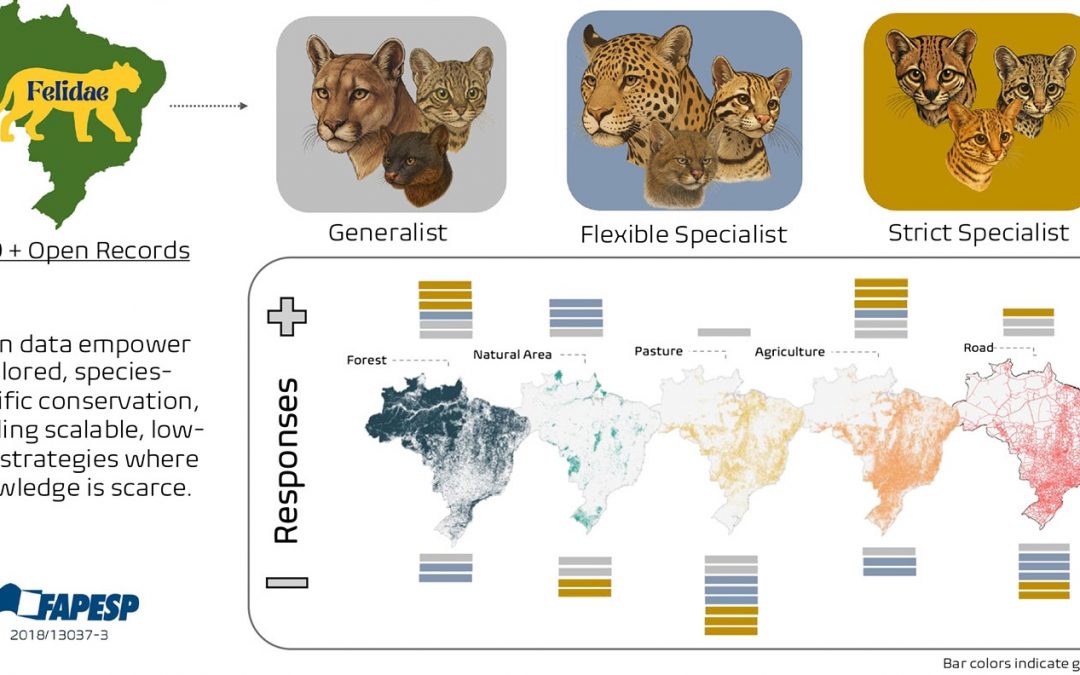
An innovative classification reveals how our wild cats respond to human-transformed landscapes
Brazil’s wild felids face one of the greatest challenges in their evolutionary history. From the majestic jaguar to the small pampas cat, these species must navigate increasingly fragmented landscapes where native forests compete with roads, pastures, and crops. But do all species respond the same way to these changes? The answer, according to our new study published in Biological Conservation, is definitely no.
The Power of Open Data
For the first time in Brazil, we used an approach entirely based on open-access data to analyze how nine wild felid species select their habitats and respond to road infrastructure. We compiled over 14,000 cleaned occurrence records from 13 different platforms, from GBIF to iNaturalist, demonstrating that collaborative science can generate conservation knowledge at a continental scale.
This innovative methodology is not only replicable and cost-effective, but also opens new possibilities for resource-limited regions where systematic monitoring has traditionally been challenging.
A Revealing Functional Classification
The Generalists: Adaptability with Limits
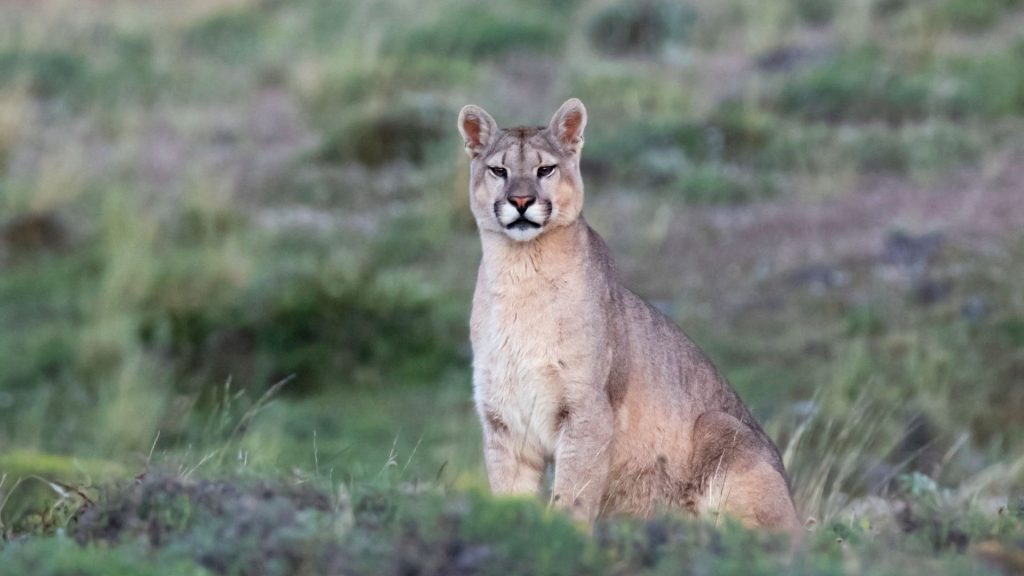
Puma (Puma concolor) and Jaguarundi (Herpailurus yagouaroundi) demonstrated notable tolerance to anthropogenic environments, but with unexpected patterns. While the puma showed preference for forests but tolerance to proximity of pastures and agriculture, the jaguarundi avoided open areas and forest interiors, depending on dense vegetation near agricultural edges.
Surprisingly, Geoffroy’s Cat (Leopardus geoffroyi), initially classified as a generalist, showed avoidance patterns toward modified areas and roads, suggesting finer specialization than expected, possibly influenced by being at the edge of its distribution in Brazil.
The Flexible Specialists: Navigating Change
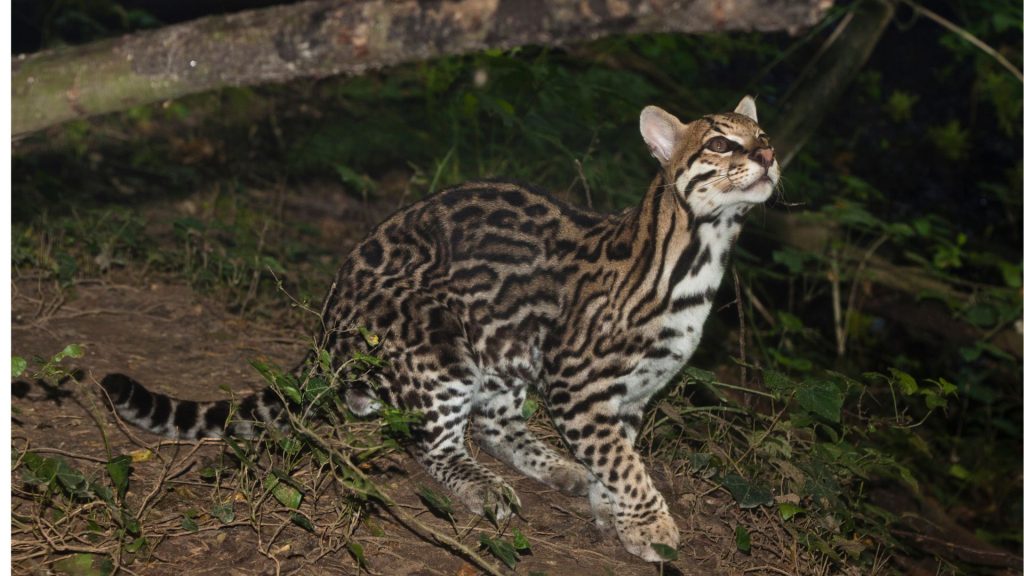
The Ocelot (Leopardus pardalis) maintained strong associations with native vegetation but showed some tolerance to agricultural zones, while the Jaguar (Panthera onca) exhibited a clear preference for natural non-forest vegetation and marked avoidance of roads, reflecting its sensitivity to human infrastructure at broad spatial scales.
The Colocola Complex (Leopardus colocola, L. braccatus, L. munoai) showed the most restrictive pattern within this group, avoiding both forested and agricultural areas, suggesting narrower specialization than previously assumed.
The Strict Specialists: Forest-Dependent
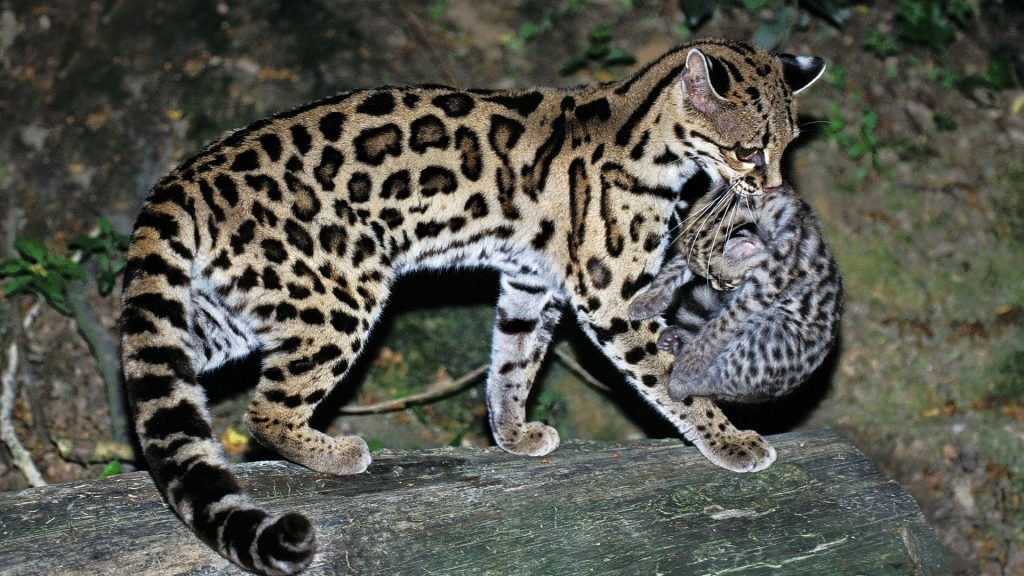
Margay (Leopardus wiedii), Southern Tiger Cat (Leopardus guttulus), and Northern Tiger Cat (Leopardus tigrinus) consistently showed strong preference for forest cover and general avoidance of anthropogenic landscapes. However, all species showed higher occurrence probability near agricultural areas, suggesting a complex interplay between edge effects, tolerance thresholds, and spatial constraints within available native habitat fragments.
Roads: An Underestimated Threat
Road effects varied considerably among species and did not always align with ecological classification. While the jaguar, margay, and surprisingly Geoffroy’s cat showed clear road avoidance, species like the puma, jaguarundi, and northern tiger cat exhibited negative associations with distance to roads, indicating greater tolerance or selective use of areas near road networks.
Implications for National Conservation
Strengthening National Action Plans
Our findings contribute directly to ICMBio’s Small Felids National Action Plan and Large Felids National Action Plan, addressing critical knowledge gaps related to:
- Species-specific habitat use: We provide habitat selection models for all nine Brazilian felid species
- Road sensitivity: We identify priority species for road mitigation and ecological corridor design
- Anthropogenic pressures: We quantify differential responses to agriculture, livestock, and fragmentation
- Spatial planning: We generate data-driven tools for identifying priority conservation areas
Differentiated Conservation Strategies
For Generalists: Maintain structural heterogeneity in agricultural landscapes by implementing agroforestry systems and riparian corridors. For Geoffroy’s cat specifically, create road-free buffer zones and mitigate rural threats.
For Flexible Specialists: Design ecological corridors, implement road mitigation measures, and maintain landscape connectivity. For jaguars, prioritize protection of Pantanal wetlands and transitional areas.
For Strict Specialists: Protect large continuous forest blocks, restore ecological connectivity, and maintain strict native habitat protection. These species require the most urgent conservation measures given their limited plasticity and fragmented ranges.
Looking to the Future
This study demonstrates the transformative potential of integrating open-access biodiversity data with robust statistical analyses to inform large-scale conservation. While the proposed functional classification did not fully predict individual species responses, it provided a valuable framework for structuring hypotheses, identifying general trends, and guiding comparative assessments.
The long-term persistence of vulnerable felids, especially strict forest specialists and potentially underestimated species like the Colocola complex, depends on specific, contextually appropriate conservation actions based on solid scientific evidence.
Brazil’s landscapes are changing rapidly, but with tools like these, we can better anticipate species vulnerabilities and design more effective conservation strategies to protect the country’s extraordinary felid diversity.
This work represents an international collaborative effort led by the Spatial Ecology and Conservation Laboratory (LEEC-UNESP) in partnership with Panthera and multiple Brazilian institutions, demonstrating the power of collaborative science to address complex conservation challenges.
If you have any questions or would like the full article, please contact me. If you’d like to check out the first draft of the article (2021), here’s the link.
Full reference: Alegre, V.B., Sepulvida, R., Oshima, J.E.F., Azevedo, F.C., Kanda, C.Z., Morato, R.G., & Ribeiro, M.C. (2025). Ecological traits explain wild felid responses to human-modified landscapes in Brazil: An open-data approach for conservation. Biological Conservation, 311, 111461.